Friday, November 13th, 2009...3:17 pm
A Shot Chart is Worth a Thousand Words
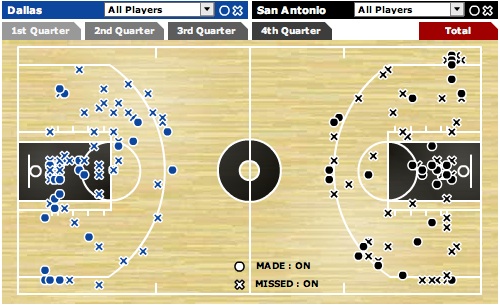
Although the tactical details of basketball can be rather complicated, the underlying strategy is surprisingly simple. At a certain point, it is merely a question of number and proximity.
You get a certain number of points for a certain type of shot and another number of points for a different shot, and that number changes in regards to one’s distance from the basket. But that number makes an absolute as opposed to a relative change: You can move further and further away and still score the same amount of points as when you are right next to the basket. But at a certain point you move an inch further, and suddenly the amount of points you score for a made basket goes up.
This concrete spatial reality leads to an obvious set of strategic goals: When inside the area where you receive less points, you want to score as close to the basket as you can. But you also want to take a certain amount of shots from the area where they are more valuable. In turn, you want to keep your opponent from scoring at the basket or from the perimeter, where points are more valuable, and instead allow them only to shoot the less valuable shot but from a distance.
Put less laboriously, make layups and shoot threes. Make your opponents take mid-range jumpers and little else. It’s the best way to balance questions of value and distance.
Now look at the shot chart from Wednesday night’s Mavs-Spurs game. The Spurs shot attempts are clustered in the paint and along the 3-point line, exactly where they should be. The Mavs have some baskets clustered around the rim, but few along the 3-point line. More importantly, shot attempts by the Mavericks litter the 12-18 foot range.
In other words, the Spurs achieved the team’s most fundamental strategic imperatives and did so damn near flawlessly.
Historically the Mavericks have exposed certain flaws in this strategy. Josh Howard, Jason Terry and, most importantly, Dirk Nowitzki are all tremendous mid-range shooters. Stopping the Mavs requires more than just formidable defense along the perimeter and at the rim.
Enter Antonio McDyess, Matt Bonner and Keith Bogans, all of whom took their turn guarding Dirk throughout the night.
Throwing a wide array of defenders at Nowitzki has been Pop’s strategy for years and it has worked to varying degrees. Antonio McDyess was clearly the most successful on Wednesday, which is not at all surprising. Although it’s hard to say that an elite talent like Nowitkzi ever “struggles,” I would argue he has the most difficulty with savvy, physical defenders who know how to use their body without drawing the foul. McDyess is one of those defenders.
Don’t take my word for it. Listen to the man himself:
Bonner and Bogans deserve credit for their efforts as well. Bonner is easily taken off the dribble, while Bogans does not have the height to defend Dirk’s mid-range jumper. But at a certain point defense comes down to tenacity and both Bonner and Bogans were relentless on the defensive end of the floor.
The fact of the matter is, Dirk is going to score. I’m content to know that, every time he took a shot, he did so with a hand in his face.

9 Comments
November 13th, 2009 at 3:57 pm
It’s funny to me that you chose this. I literally charted each Spurs shot by possession for this game and came away thinking they took a ton of shots from the perimeter. Obviously, the majority were 3-pointers. I didn’t compare it to the Mavs though.
What stands out to me on your chart is the number of misses by the Mavs in the paint.
November 13th, 2009 at 4:25 pm
its so gorgeous, this belongs in basketball heaven
November 13th, 2009 at 4:28 pm
It looks like the Mavs attempted the majority of their midrange shots from the right side of the court. Is this just a coincidence? Or was it intentional?
If it was intentional, it because the Mavs wanted to shoot from the right, or because the Spurs D pushed them to shoot from there?
November 13th, 2009 at 4:34 pm
AP,
I’ve got a hunch that’s where Dirk likes to get the ball most of the time. Considering he went 9-27, i’m betting a lot of those clanks are his.
November 13th, 2009 at 6:59 pm
Could be, but it also looks like the Mavs just missed A LOT of interior shots on this particular night. By the looks of the graphic it appears they had just as many opportunities in the paint.
The problem with these charts is that they tells us little about the quality of the interior baskets scored (e.g., were they indeed lay-ups? Contested? Was the defending team executing especially crisp double teams down low?) This graphic however, illustrates the Mav’s longstanding lack of a dependable low post threat.
November 13th, 2009 at 9:22 pm
Some Mav was playing pretty well on the left block. They should add a third symbol to the graphic to indicate fouled shot attempts. When Dirk can get the ball close to the basket, he’s at least probably going to the line. In the first half, it’s hard to say whether it was the Mavs’ gameplan or McDyess’ defense, but Dirk had to work his way in from that no man’s land on the right side of the basket. He’s used to the jab-step and pullback jumper out there, but Dice was having none of it. It looked like he forced him into a lot of contested, face-up jumpers that turned into those blue ‘x’s. I don’t know if it’s because he was putting a body on him way out there before he even got the ball or what, but I was impressed. Everyone else should take notes. I wasn’t as pleased by Bonner and Bogans; I think after a point Pop was just testing those matchups out for the next time we see Dallas. They have plenty to work on til then.
November 14th, 2009 at 1:15 pm
Graydon,
good point.
On the same note, I think it is also important to consider the difference in attempted corner threes (basically, three pointers from the long 2 range).
The Spurs took 14 of them, while the Mavs only took 6 of them. Probably it wasn’t a factor in this particular game, since most of ours went out, but taking & denying corner threes is a big big plus for any team.
Best,
Nick
November 14th, 2009 at 6:51 pm
Does anyone wonder why Pop’s line-ups have been so inconsistent? I think that it has been affecting the play of some key guys, including Roger Mason. I wish Pop went with a more traditional line-up (Duncan, McDyess, RJ, Bogans, Parker). Blair & Bonner should sub-in for Duncan/McDyess depending on offense/defense situations. Ginobli comes in for Bogans. Hill comes in for Parker. RJ should play 38 minutes with limited minutes given to Finley.
November 15th, 2009 at 7:49 am
going off topic a bit…i am a bit concerned about having our players work together as a team. right now it reminds me of the lakers roster with o’neal, malone, bryant and payton…loads of individual talent, still not much team cohesion. that will not win a championship. it’s not about having the best individual pieces but rather having the best team fit of the best pieces. pop has his work cut out for him this year…
Leave a Reply