by Graydon Gordian

December 23rd, 2009

Portland Trail Blazers 98, San Antonio Spurs 94

i-2The air of optimism I had begun to breathe was sucked from the room this evening when the Spurs fell to the woefully undermanned Blazers 98-94. There’s always a temptation to point to a few particulars and excuse the loss: We took 21 three-pointers, only six of which went through the net even though the vast majority were decent looks. And we consistently forced the Blazers into taking long jumpers late in the shot clock, many of which happened to fall. As Coach Pop often says, they made shots; we didn’t.

Other details are far more damning. For instance, we were outrebounded by a team that, because of injuries, was left without its first and second string centers. More specifically, we allowed a combination of Juwan Howard, Jeff Pendergraph, and Dante Cunningham to corral 20 boards, six of which were offensive (the Blazers had 11 offensive rebounds overall). When your frontline is composed of Tim Duncan, DeJuan Blair, and Antonio McDyess, there is absolutely no excuse for that.

There are several other macro elements to bemoan: the Spurs turned the ball over excessively in the first half (although my choice of adverb begs the question, “what is an unexcessive turnover?). After going 13-14 from the charity stripe in the first, the Spurs only took three free throw attempts in the second half. And, generally put, the Blazers seemed more prepared to play a physical brand of basketball. But there are a few specific tactical elements of the game that I found interesting/confusing that I’d rather focus my recap on.

Keep reading →

by Timothy Varner

December 23rd, 2009

Christmas Wish: Play Ian Mahinmi

Okay. This one has taken me by surprise.

When the Spurs declined Ian Mahinmi’s contract option, I didn’t expect it to mean he wouldn’t play. You know, as in not at all. Zero minutes through 25 games.

Keep reading →

by Timothy Varner

December 23rd, 2009

Advanced Box Scores

You may know Joseph Treutlein from his work at DraftExpress. A few months ago he launched a must-bookmark site called Hoopdata.com. Hoopdata is a treasure trove of statistical riches. Click the link, check it out.

After the launch of Hoopdata, Treutlein reached out to a few bloggers, myself included, for feedback and suggestions for his site’s direction forward. My big wish was for Hoopdata to push the box score into this century-the traditional box score is increasingly archaic and unhelpful. And, boy, did they come through.

Earlier this week, Hoopdata unveiled an advanced box score, one that is current with contemporary analysis. It’s available shortly after each game and should prove a tremendous help in understanding what actually happened between the buzzers. For an example, scan the advanced box for Monday’s Clippers-Spurs contest.

And for you naysayers, this isn’t really about fancy new metrics. It’s actually the small things that make the advanced box score project so promising. I’m happy to see the inclusion of simple things: charges drawn, points contributed, assist percentages. The sort of things that we already talk about, but which we had no easy way to monitor. Until now.

by Graydon Gordian

December 22nd, 2009

Other People: Arnovitz on Kaman and the Spurs D

Via Clipperblog:

The book being drafted by most of the league on Chris Kaman instructs teams to swarm the Clippers’ big man with double-teams when he catches the ball at 15 feet. But Spurs coach Gregg Popovich’s reading list is self-authored and it reads something like this: “We’re the San Antonio Spurs. We deploy a stay at home strategy. If a guy like that has a big night and his team loses by double-digits, then so be it.” The Spurs will cheat ever so slightly, and if Kaman spins middle, they’ll certainly collapse, but by and large this has been their strategy against most post scorers for as long as we can remember, and it rarely fails.

Before last night’s game a reporter asked Gregg Popovich what kind of preparation the team does for each particular opponent.

“It’s not like you’re inventing the wheel everytime for a new team,” said Popovich. “If you know what you do and your solid in your defenses and your offenses, getting better at those is more important than changing things for every team that you play.”

Kevin has further articulated exactly the point Coach Pop was hoping to make. Yes, the Spurs do spend some time at practice discussing what makes their next opponent distinct. But there is no need to outsmart yourself on a nightly basis- decisions about how to defend the pick-and-roll or whether to double the low post iso are made long before Chris Kaman puts up 15 in the first half. It seems obvious to say, “there is no need to stray from your defensive system just because one opposing player is having a nice game.” But it’s surprising how few coaches have the poise to follow through with that statement.

by Graydon Gordian

December 21st, 2009

Los Angeles Clippers 87, San Antonio Spurs 103: the Early Edition

i-1

There are lots of positives to take away from tonight’s victory over the Los Angeles Clippers: the continued excellency of Tim Duncan; Tony Parker’s reignited aggressiveness; and what you might generally refer to as 48 minutes of sustained focus on both ends of the floor. But for me the story of the game is the play of the Spurs second and third tier players: Keith Bogans, Roger Mason Jr., Antonio McDyess and Theo Ratliff.

Keep reading →

by Graydon Gordian

December 21st, 2009

Clippers at Spurs Liveblog

I’ll be hanging around ESPN’s nightly live chat throughout the game as well as haunting the old twitter page from time to time. Stop by either if you have a chance, or leave your thoughts about the game in the comments section. Go Spurs.

by Graydon Gordian

December 20th, 2009

Read Between the Lines

Play-by-Play

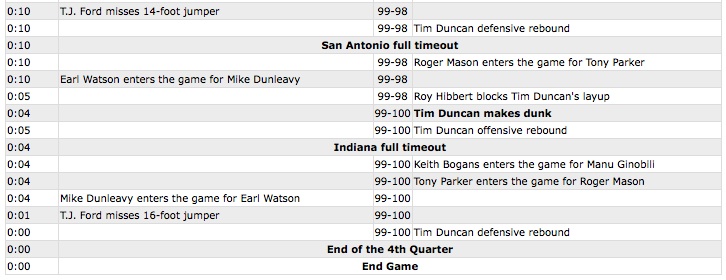
Above is the play-by-play for the final ten seconds of last night’s game against the Indiana Pacers. Hidden inside this very standard and typically unhelpful form of score-keeping is a wealth of information about what has been going right and wrong for the Spurs this season.

Keep reading →

by Graydon Gordian

December 19th, 2009

Indiana Pacers 99, San Antonio Spurs 100

An awkward celebration befitting an unexpected ending.

Well, that was far more stressful than I had anticipated. In a game that Gregg Popovich described as an “ugly win,” the Spurs defeated the Pacers on a go-ahead dunk from Tim Duncan with four seconds left.

After an excellent 1st quarter that ended with a Matt Bonner and Manu Ginobili led run, the team fell flat for the middle stretch of the game. The Spurs scored only 40 points in the second and third quarters combined but allowed the Pacers to score a gaudy 62 over that same period. 38 of those 62 came in the third.

The Spurs second quarter struggles seemed to stem from the absence of Matt Bonner, who left the game in between the first and second with a broken bone in his right hand. It’s hard to say he was the definitive cause of their drought; even on his best days he is a secondary offensive figure. But the spacing and spark he provided in the first was sorely needed at the close of the second, as the Spurs failed to score for the final three and a half minutes of the first half.

That’s not to say the Spurs didn’t have chances to score. They missed four free throws during that span. I’m sad to report that those would hardly be our last unproductive trips to the charity stripe.

Keep reading →

by Graydon Gordian

December 19th, 2009

The Prodigal Son Returns

It’s no secret that over the past few weeks my contributions to 48MoH have grown more infrequent. Rather than partake in some self-involved mea culpa, I’ll just say that I’m back in Texas for the Holidays (always a rejuvenating experience) and am looking forward to spending some hard-earned leisure time covering my favorite basketball team. I’ll be attending the five home games the Spurs have between now and the end of the month, which will offer me a chance to do some actual reporting as opposed to the mindless speculation we peddle around here typically.

My annual pilgrimmage to the house that Duncan built begins with tonight’s game against the Pacers. If you’re wondering how Pacers fans are feeling headed into this evening, check out Jared Wade’s preview at Eight Points, Nine Seconds.

Update: I’ve decided to “tweet” during the game, so stop by our twitter account if you’ve got the time (two things: a) I bet you didn’t even know we had a twitter acount, and b) It’s saturday night, you really shouldn’t be staring at twitter.)

by Timothy Varner

December 18th, 2009

Gladwell, Spurs, Capitalization Rate

Malcolm Gladwell, talking with Bill Simmons:

What we’re talking about is what are called capitalization rates, which refers to how efficiently any group makes use of its talent. So, for example, sub-Saharan Africa is radically undercapitalized when it comes to, say, physics: There are a large number of people who live there who have the ability to be physicists but never get the chance to develop that talent. Canada, by contrast, is highly capitalized when it comes to hockey players: If you can play hockey in Canada, trust me, we will find you. One of my favorite psychologists, James Flynn, has looked at capitalization rates in the U.S. for various occupations: For example, what percentage of American men who are intellectually capable of holding the top tier of managerial/professional jobs actually end up getting a job like that. The number is surprisingly low, like 60 percent or so. That suggests we have a lot of room for improvement.

What you’re saying with the NBA is that over the past decade, it has become more and more highly capitalized: There isn’t more talent than before, but there is — for a variety of reasons — a more efficient use of talent. But I suspect that in sports, as in the rest of society, there’s still an awful lot of room for improvement.

This isn’t the first time Gladwell has written something that provided a window of insight into the Spurs. In many ways, seeking an optimum capitalization rate is a quick tutorial in how Buford and company operate. One could come at this from multiple angles, so I’ll tease you in a few directions rather than overstating the point.

Gladwell makes a case of Peyton Manning, but it could just as easily apply to Tim Duncan. He writes:

Case in point: Everyone always says what an incredible advantage it has been for Peyton Manning to have had the same offensive coordinator and the same offensive system his entire career. Football offenses are so complex now that they take years to master properly, and having one system in place from the beginning has allowed Manning to capitalize on every inch of his talent. On the other hand, someone like Jason Campbell has had a different offensive coordinator in virtually every season of his pro and college career (and I’m guessing he’ll get another this offseason).

This is what Gregg Popovich likes to call “corporate knowledge,” and the Spurs value it like miners value diamonds. A lack of corporate knowledge is the major obstacle standing between the current Spurs team and their next championship, and Popovich knows it. Past Spurs squads were better defenders because their corporate knowledge allowed them a higher capitalization rate, despite less youth, athleticism and talent. The advantage of being the oldest team in the league is, perhaps, that the talent assembled will capitalize on the team’s schemes at a higher rate than a collection of more talented but system-ignorant newcomers.

As a small market team, the Spurs have done more under the restraints of the salary cap than the rest of the league; Popovich has consistently squeezed more production from players like Bruce Bowen than anyone thought imaginable; the front office has found ways to get more out of the draft than most, if not all, of their opponents (relatively late selections of Ginobili, Parker, Splitter, Blair and Hill, as examples), and their investment in the Austin Toros (including the once passed-over coaching talent Quin Snyder) is nothing if not an adventure in converting under-realized talent into NBA production.

The comparisons don’t work in every way, but the Spurs have had one the best capitalization rates in all of sports over the last decade.

by Graydon Gordian

December 17th, 2009

Colonels vs. Spurs, March 10, 1976


Why forget when you can remember. (H/T Shoals)

by Timothy Varner

December 16th, 2009

The Spurs Might Be Broke

In today’s Daily Dime, John Hollinger picks up on a few themes that are popular to 48MoH this season. We’ve recently written that this year’s Spurs team is Tim Duncan and too little of everyone else. Hollinger agrees:

…Tim Duncan is playing unbelievably well. On Tuesday, he had 34 points, his most since scoring 40 in a double-overtime thriller against this same Suns team in Game 1 of the 2008 playoffs. It was an efficient 34, too, as he shot a stellar 14-of-22 from the floor. Yet it still wasn’t nearly enough — the Spurs lost by double figures as his teammates shot only 40.6 percent from the floor.

And then Hollinger picks on Richard Jefferson:

…Jefferson was awful. He dunked on a sweet baseline drive on the Spurs’ second trip and then disappeared the rest of the night, to the point that the Spurs kept him on the bench for the final 6:05 and used Roger Mason in his place.

Oh, and much like Spurs fans everywhere, the good professor wonders about San Antonio’s defense:

I can’t remember seeing a Duncan-era defense lit up the way it was in the second quarter Tuesday. Phoenix scored 39 points, en route to getting 67 for the half, and built the lead up to 20 points early in the third quarter before the Spurs mounted a too-little, too-late comeback. This was doubly notable because it came against the Suns — a club the Spurs normally defend as well as any team in the league.

These three themes have found steady play at 48MoH since the first week of the season. The question before the team is not simply “How to clean up this mess?” No, that’s a follow up question. The primary question before the team is “What kind of mess is this?” The answer isn’t obvious.

This current Spurs team has played together for all of 22 games. “Give them time,” that’s what the Spurs faithful likes to say. But I’m not convinced that’s the kind of sober-minded reflection needed to right this ship. Gregg Popovich issued a “no more excuses” mandate earlier this week, saying “we’ve taken enough time.”Still, the fan-boy knee-jerk amongst the Spurs crowd is a plea for patience.

The “give it time line” is starting to sound a little too much like the life-long smoker who is to happy to tell you about his Uncle Tom-the uncle who lived to 95 and smoked a pack a day. Such anecdotes are rehearsed with dismissive glee right up to the moment your friend, the smoker, is diagnosed with lung cancer. After last night’s game, Manu Ginobili said, “I’m not sure if it’s just chemistry. We’re not playing well.” Manu Ginobili doesn’t want to tell you about his lucky uncle; Manu Ginobili wants to quit smoking.

The Spurs’ front office is in a tough spot: they have until February to figure out if this roster possesses the right mix of players to legitimately compete for a championship. Given San Antonio’s difficulty beating quality opponents, it’s a fair question to ask. Is this simply a will-fix-itself-in-time chemistry issue, or are there bigger problems at play?

Here’s the issue, put differently: if the Spurs shake up the roster between now and February, they’ll prolong the new-faces learning curve and introduce even more discontinuity to a team already facing at least some chemistry issues. A major shake-up would seem to compound any of those problems. But, of course, this current Spurs team is on a short clock. Patience must be held in balance against the reality of imminent decline.

If Ginobili’s suspicion is correct-that there is something more than a chemistry issue at play-the Spurs will have no choice but to examine more radical measures, especially in light of their short championship window, a rapidly aging core, and a pregnant-with-tax payroll.

Having said that, the Spurs are not far from legitimate contention. The Spurs are playing poorly relative to expectation, but John Hollinger’s magic calculator still ranks them as the 6th best team in the league. They’re ranked ahead of every Western Conference team, save the Lakers. Yes, the Spurs are underachieving. Their kind of underachievement is enough to give them even odds to make it to the Western Conference Finals.

But everybody knows the Spurs don’t fix their eyes on finishing second in the conference, and life in San Antonio is fairly meaningless if it’s not lived in the winner’s circle. You don’t go neck deep into tax to finish a notch below. So either the Spurs need to dramatically improve their play, or the team’s button pushers will have to make a sharp, decisive move to correct the problem. It’s probably never been true before, but it is now. The Spurs’ future is on the line, at least the Spurs as we’ve known them for the last decade.

by Graydon Gordian

December 14th, 2009

Other People: Arnovitz Dissects the Spurs Offense

I love when we play the Clippers because my beloved Spurs get treated to the inimitable stylings of Kevin Arnovitz, who is one of my favorite hoops scribes (and, in full disclosure, my brother from another mother). From Clipperblog:

The patented Spurs Corner 3 off the drive-and-kick is a lethal novelty, but the Parker-Duncan screen-roll is an enduring monument. The Clippers choose to trap Parker, with Marcus Camby acutely aware to focus on nothing but the rolling Duncan. What makes Duncan the most fluent low post practitioner of our lifetime is how he eludes even the best help defenders with his agility and touch:

Swing by Clipperblog for more analysis of last night’s victory over the Clippers, which Arnovitz referred to as “vintage Spurs basketball.”

by Timothy Varner

December 14th, 2009

DeJuan Blair: “Im ok!!!”

Thanks to the magic of Twitter, we needn’t worry about the condition of DeJuan Blair, who took a nasty fall in last night’s game. He tweets he’s fine.

by Timothy Varner

December 14th, 2009

Tony Parker as Steve Nash

Tony Parker assisted four of the first five San Antonio baskets, leading the Spurs to a commanding early lead against the Clippers. The Clippers would eventually battle back with a run of sorts, but last night’s game was over soon after it began.

Tony Parker is credited with with 28 assists over the last three games, games in which he’s played a total of 99 minutes. The Spurs’ already efficient offense has looked explosive, and Parker may have refined his role on this remade San Antonio team. When the Spurs get Richard Jefferson and Manu Ginobili involved early, the offense starts to hum. And this despite a horrendous stretch of high turnover contests. It seems counter-intuitive, but it’s right there for us to see.

Tony Parker’s point play is at the center of the latest version of the 2009-10 Spurs-the team is a brief 21 games in, but it feels like the Spurs have already shed their skin two or three times this season. Version 3.0 defeated the Clippers last night.

To suggest that Tony Parker is playing like Steve Nash is a moment of hyperbole. You know that. But the last three contests have seen Parker assume a distinct pass first mentality in the first quarter. Of his seven assists, five came in the first quarter. His first shot attempt of the game came with 4:20 remaining in the first, and it was his only attempt of the quarter. Richard Jefferson was 3 for 5 on the quarter; Manu Ginobili was 2 for 3.

The results of the Charlotte game (two victories back) are less obvious, but consider that Parker only attempted seven shots against the Bobcats. And that Richard Jefferson and Manu Ginobili finished with 17 and 22 points, respectively.

Against the Kings, if you recall, Parker found Richard Jefferson for a scripted-gasp-alley oop on the game’s fifth possession. Parker finished with 11 assists, 7 of which came in the initial 12 minutes.

I call your attention to the trend, which, I admit, may turn out to be nothing. But it’s a potential watershed moment for the Spurs’ title contention, and the development of Tony Parker’s game. In some ways it’s a chicken and the egg conversation. Is Tony Parker collecting early assists because the Spurs are starting to play well? Or, perhaps, are the Spurs playing well because Tony Parker is making a concerted effort to find his teammates?

One wonders if the recent rash of turnovers owes anything to the the Spurs’ conscientious attempt to invoke that time-honored Judeo-Christian ethic of the pass shall be first. That, and a measure of makes-you-grimace sloppiness. At any rate, the Spurs have tallied an awful 54 turnovers in the previous three games. But I see more than a sliver of silver in those dark clouds.