
Offensive rebounding, transition defense and the Spurs
A week ago, Grantland’s Zach Lowe wrote a very cool piece debunking the myths of offensive rebounding and transition defense as they correlate to championship-caliber success in the NBA. This conversation is relevant here in San Antonio — as Zach points out in his column — given the outright concession of offensive rebounding Gregg Popovich has always practiced in favor of elite transition defense. Lowe wonders if the former truly has a definite effect on the latter, or if the likes of Pop and Doc Rivers have reacted to the extreme in their efforts to ensure the opposition doesn’t get easy baskets out in the open floor. The truth is, there seems to be a more healthy medium than these coaches’ strategies might lead us to believe.
Please read Lowe’s column before proceeding. He covers a ton of this stuff in detail, including bits from the Spurs’ perspective. I’m going to elaborate here rather than regurgitate the information he presented.
Pop’s aversion to chasing offensive boards has become well-known by this point. San Antonio is regularly at or near the bottom statistically when it comes to offensive rebounding rates, something that’s very much a result of strategy. But while we may view this as a tried and true strategy the Spurs’ coaching staff will implement regardless of personnel, the fact is that Popovich’s rosters have, in large part, maintained similar characteristics. But there’s one trait in particular that affects a team’s transition-defense theory more than most.
The Tim Duncan era Spurs have hardly been a model of athleticism. They’ve had their waterbug in Tony Parker and their sidewinder in Manu Ginobili, but rarely have they had that prototype, straight-line, high-flying NBA wing player to supplement their foundation. Over the years it’s been the uber-athletic teams that have given San Antonio problems, primarily through forced turnovers and multiple transition opportunities. So, the counterpunch is obvious: take care of the basketball, get good shots through the flow of the offense and run the hell back en masse on defense.
But we began to see this strategy shift a bit during the NBA Finals, and much of that is because of the new toy Popovich had at his disposal. The 17-year head coach has never had a Kawhi Leonard type on his roster, and against a Miami Heat team that was notably bad on the glass he utilized him. Leonard averaged about one offensive rebound per game during the regular season, a number that tripled in the Finals because of the freedom Popovich afforded the young forward.
The aforementioned shift in strategy was hardly seismic, however. Again, the Heat struggled badly on the boards — they got mauled on the glass by the Pacers in the Eastern Conference Finals — given their relative lack of size on the interior. San Antonio’s offensive-rebound percentage jumped from 20 percent during the regular season to 26 percent in the Finals, but much of that had to do with the opposition. Still, Pop made a subtle move* that allowed the Spurs to put pressure on the Miami rebounding woes while still maintaining their presence defensively in transition.
*Who knows if Pop even told Kawhi specifically to go crash the offensive glass. It’s inherently against his nature to do so. But Leonard was visibly more active as an offensive rebounder than what we’d seen during the regular season, so there was a change. It may have been as simple as Popovich letting go of the leash, so to speak.
And that’s the conundrum when you play the Heat. Sure, they might be bad on the glass, but they’re as terrifying a team in transition as there is in the league. One misstep or any overcommitment on the offensive glass and you’re dead. But San Antonio used Miami’s transition aggressiveness against them by barraging them at the point of attack. Any Heat fast break begins and ends with LeBron James and Dwyane Wade, and because of this there’s a natural tendency between the two of them to shift their focus toward the run-out before a defensive rebound is secured. The Spurs countered that beautifully.
Leonard’s presence as a rebounder at the small forward position is arguably his greatest asset, and it was utilized heavily against Miami. Popovich maintained the overarching team strategy to retreat quickly on defense when a shot went up, but with one exception: he gave Leonard almost complete freedom to pursue offensive rebounds when the situation called for it. Whether it was from the baseline — something Lowe touched on quickly at the end of his piece — or off dives from the perimeter, Leonard’s activity kept James and Wade honest throughout the Finals, preventing them from leaking out and running.
With Duncan preoccupying his own defender on the low block whenever shots went up, James and Wade weren’t getting much help containing Leonard, especially when he was their defensive assignment. Not only did this prevent them from kickstarting their beloved run-outs, it caused Miami’s two best players to expend more energy on the defensive end.
And one of the reasons this strategy worked so well was Danny Green’s activity defensively, especially in transition. This was a familiar site over the course of those seven games: As Leonard dove toward the paint in an effort to pressure James, Wade and the Miami interior, Green would counter his motion by essentially replacing him at the top of the offensive possession.
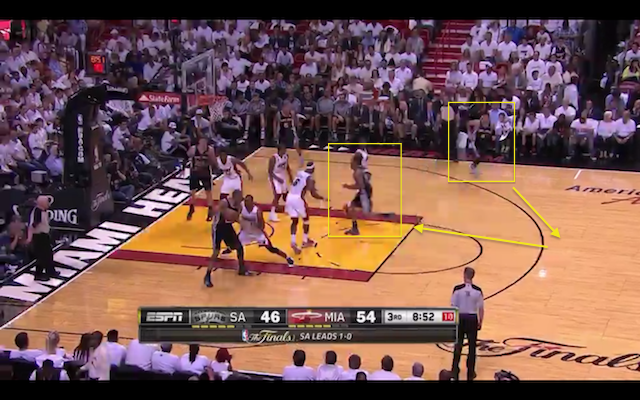
Screenshot courtesy of NBA.com
This was a common theme: when Leonard crashed the boards the rest of the perimeter players would run back. Of course this makes sense, as Green is an excellent 3-point shooter as well as defender. His outside shooting escapades were well-documented, but let’s not forget all the times this happened on the back end…
Who knows if we’ll see more of this over the course of the 2013-14 season? Somehow I doubt Popovich went through some wild ideological change, and with a roster that’s essentially the same you’d probably be safe to bet on the Spurs finishing near the bottom of the league in terms of offensive-rebound percentage once again. But the Leonard-Green dynamic is something we’ll watch more of as the two share more court time together.
Again, this goes back to the building-block idea: Little by little, block by block, these two are gaining more freedom within the Spurs’ system. But, in an effort to be LESS predictable and systematic, there’ll likely be more freelance opportunities for the young backcourt to exercise their abilities. San Antonio is conservative by nature during the regular season, and with another title run in mind it will certainly make a concerted effort to save players’ legs, as usual. Still, Pop has never had a player like Leonard before, so placing him in the mold of something or someone we’ve watched at any point during the Popovich-Duncan-Ginobili-Parker era may not be ideal, because there hasn’t been one to begin with.
He’s not Bruce Bowen. He’s not Sean Elliott. Leonard brings a different, more well-rounded set of skills to the table than either of them. As a player, he breaks the Spurs’ mold; from a personality perspective, he fits it perfectly. He and Green have allowed this team to combine its past identities as both offensive- and defensive-minded and bring both ideas together in the same package.
As Leonard develops offensively, the one thing he’ll always have in his back pocket is his ability to force the issue on the boards. If ever there’s been a Spurs team that can debunk the myth that you can’t be a top offensive rebounding team and a high-end transition defensive team at the same time, it’s this one.
But I wouldn’t bet on Popovich sacrificing the latter just to find out.